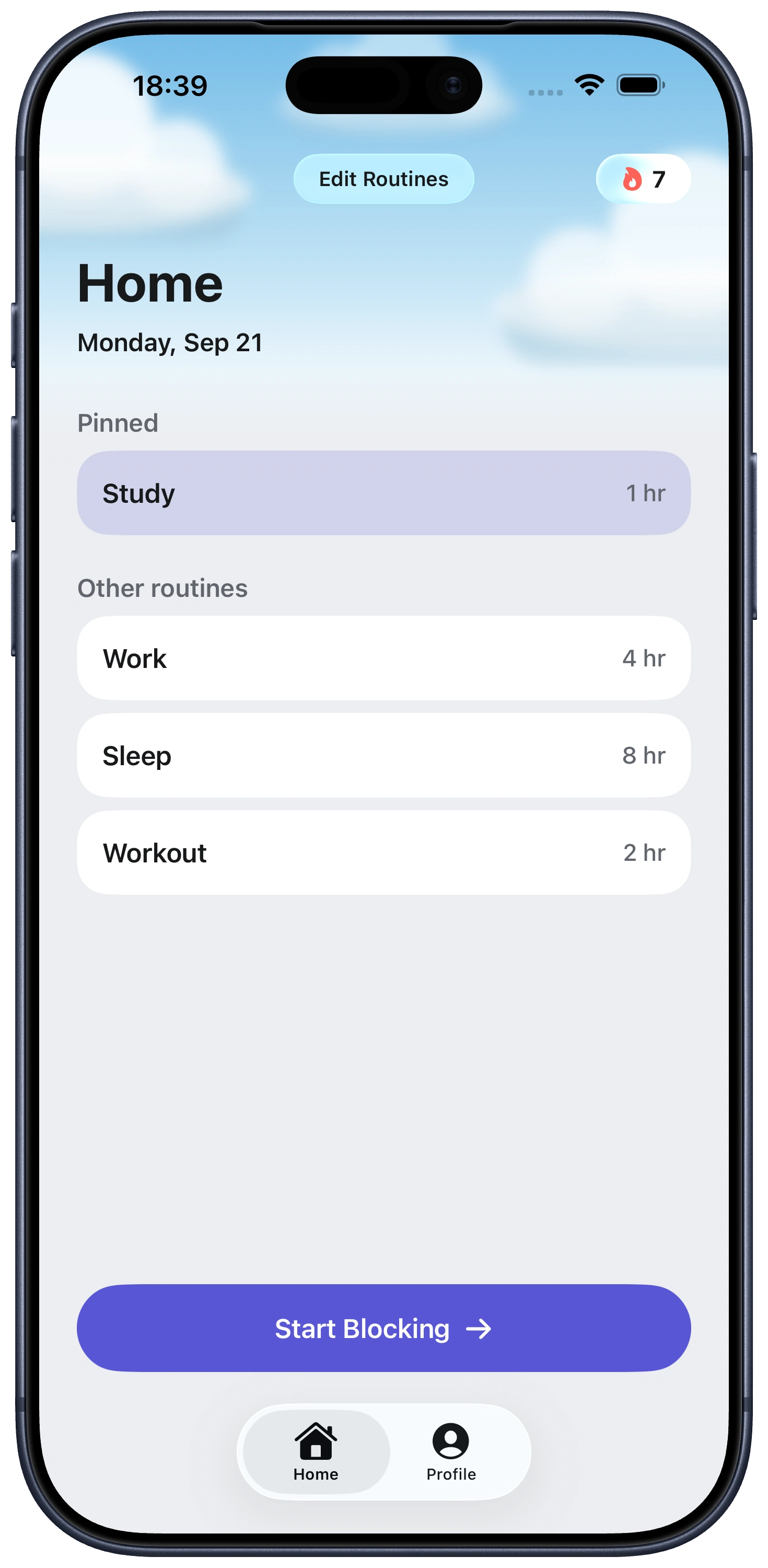
Fella vs Brick

Tap in, tap out.
Fella skips the object.

Brick locks and unlocks your apps with a tap against a $59 physical device you have to carry, place, and remember. Fella does it in software, with one 5-minute unlock per session and nothing to buy or lose.
Brick's idea is genuinely clever: a small NFC puck you tap your phone against to lock your selected apps, and tap again to unlock them. Its real strength is physical separation, put the Brick in a drawer or your car, and the friction of retrieving it becomes your barrier. It's a one-time $59 purchase with no subscription, which is a fair trade for a lot of people.

The tradeoff is that the barrier is exactly as strong as your willingness to keep the object away from yourself. Tapping back in takes the same one second as tapping out, and the device has to be charged, findable, and physically with you or wherever you left it, to matter at all. Fella's block lives entirely in software, on the phone itself, with one 5-minute emergency unlock per session instead of a tap you can do anytime you're near the puck.

It's a passive tag, not a gadget, which is smarter than it sounds

Brick has no battery. The NFC chip inside is passive, powered entirely by your phone's own NFC field the instant you tap it, so there's nothing inside to charge, drain, or eventually stop holding a charge. That's a genuinely good piece of hardware design, one less way for the product to quietly fail.

What it can't remove is the physical part of "physical." A tag that never dies still has to be somewhere you can reach, or can't reach, depending on which side of the barrier you're relying on. Leave it at home, lose it in a bag, and the unlock or the lock, whichever you needed, isn't available either way.

Fella's barrier lives entirely in software. There's no object that can be forgotten on a different day, because the only thing standing between you and a blocked app is the same unlock per session, present on the phone itself.

Built on a real idea about friction, just a different kind

Brick was founded in 2023 by TJ Driver and Zach Nasgowitz, students at the University of Wisconsin-Madison, around a genuinely sound insight: distance from an object creates real friction that a software toggle doesn't. Put the puck in a drawer, and getting back in requires a trip across the room, not a tap on a screen.

Fella is built on the same underlying insight, minus the object. Instead of distance from a device, the friction is a fixed daily limit with no override, no drawer to walk to, no puck to place somewhere inconvenient on purpose. The barrier is the rule itself, not where you left something.

At a glance Fella Brick
Hardware required None $59 physical NFC device
Battery to maintain None None (passive tag)
Unlock method One 5-minute daily window Tap phone to device, anytime
Setup Pick apps in the app Buy, ship, pair a physical object

Why people switch to Fella

Nothing to buy, ship, charge, or lose. Brick's device is well-built, but it's still one more object to keep track of, and losing it or leaving it behind means losing your blocking method too.

Unlocking isn't a tap away, wherever you happen to be. Brick's tap-to-unlock is exactly as available as the device is, which for most people is closer than a drawer across the room. Fella's one 5-minute emergency unlock per blocking session is the only exception, not an on-demand toggle.

No subscription either way, but no hardware dependency. Brick's one-time cost is appealing, but the product only works as long as the device does. Fella is software you already have access to the moment you set it up.

Where Brick might be the better fit

If a one-time purchase with zero subscriptions matters more than anything else, and you're disciplined about where you keep the device, Brick's physical separation is a real, tactile barrier that some people respond to better than a software rule.

Fella is for when the object becomes the weak point. If you've found yourself keeping the puck within easy reach "just in case," or losing track of it entirely, that's the exact failure mode a rule with nothing physical to manage avoids.

Fella vs Brick FAQ

Brick is a one-time $59 hardware purchase. Fella is $9.99 a month or $34.99 a year. Over a year, Brick is cheaper; over several years, the comparison depends on your usage and whether the device still works.

Without access to the physical Brick, you can't tap back in to restore blocked apps, since the unlock mechanism depends entirely on that object being reachable. Fella has no physical dependency to lose.

They're not designed to integrate, but nothing stops you from using Brick for a subset of apps tied to physical separation while Fella handles a broader all-day block.

Yes, Brick's core function is a one-time purchase with no required subscription. Fella is subscription-based, which is the tradeoff for not needing a physical object at all.

No. Brick is a passive NFC tag with no battery, so it can't die or need a charge, though it still has to be physically present and findable to tap. Fella has no object to keep charged or track down at all.

Brick was founded in 2023 by TJ Driver and Zach Nasgowitz, University of Wisconsin-Madison students who built it around the idea that physical separation creates real friction. It requires iOS 16.2 or later. It's a genuinely clever, well-reasoned product for a specific kind of barrier, software plus a physical object working together.

See Fella in action.

Own Your Attention
Starting Right Now